Animation has become an important part of today’s entertainment, advertising, gaming, digital marketing, education, film, and media industries. From animated advertisements and social media content to movies, games, product visualizations, and visual effects, animation professionals play an important role in creating engaging digital experiences.
For students and creative professionals who want to turn their imagination into visual content, a 2D & 3D Animation Course Ahmedabad can be an excellent career option. Learning animation combines creativity, storytelling, drawing, design, technology, and problem-solving to create engaging visual experiences.
Muse Art Academy offers creative and career-focused education for students interested in animation, graphic design, UI/UX, interior design, fashion design, photography, video editing, and other creative disciplines. Through practical learning and project-based assignments, students can develop the technical and creative skills required for animation-related careers.
Whether you are a student after 12th, graduate, beginner, or working professional, learning 2D and 3D animation can help you explore a wide range of opportunities in the creative industry.
Why Learn 2D & 3D Animation?
Animation allows designers and artists to communicate ideas through movement, characters, environments, graphics, and visual effects.
A professional 2D & 3D Animation Course Ahmedabad can help students understand:
- Animation fundamentals
- Character design
- Storyboarding
- 2D animation
- 3D modeling
- Texturing
- Lighting
- Rendering
- Motion graphics
- Visual effects
- Video editing
- Digital compositing
- Portfolio development
The combination of creative and technical skills can prepare students for opportunities in animation studios, advertising agencies, production houses, gaming companies, digital agencies, media companies, and freelance projects.
Why Choose Muse Art Academy?
Selecting the right institute is an important step when starting an animation career. Muse Art Academy focuses on creative education and practical skill development.
Students can benefit from:
- Practical animation training
- Industry-oriented curriculum
- Experienced trainers
- Project-based learning
- 2D animation concepts
- 3D modeling and visualization
- Motion graphics
- Software training
- Portfolio development
- Career guidance
- Placement assistance
The objective is to help students develop creativity, technical knowledge, and the confidence to work on professional animation projects.
2D & 3D Animation Course Curriculum
A strong animation curriculum should introduce students to fundamental design principles before moving into advanced animation and visualization.
1. Introduction to Animation
Students begin by understanding animation principles, different animation styles, production workflows, visual storytelling, and the role of animation in modern media.
They learn how static artwork can be transformed into engaging visual experiences through movement and timing.
2. Principles of Animation
Students explore fundamental concepts such as:
- Timing
- Spacing
- Squash and stretch
- Anticipation
- Follow-through
- Slow in and slow out
- Arcs
- Exaggeration
- Staging
- Pose-to-pose animation
Understanding these principles helps students create more natural and visually engaging animation.
3. 2D Animation
2D animation focuses on creating movement in a two-dimensional environment.
Students can explore:
- Character animation
- Motion graphics
- Storyboarding
- Digital illustration
- Background design
- Frame-by-frame animation
- Character poses
- Scene composition
2D animation is widely used for advertisements, explainer videos, educational content, social media, entertainment, and digital campaigns.
4. Character Design
Characters are an important part of animation and storytelling.
Students learn how to develop:
- Character concepts
- Facial expressions
- Body proportions
- Character poses
- Costumes
- Color palettes
- Character personalities
A strong character design can make animated content more memorable and engaging.
5. Storyboarding
Before animation begins, designers often need to plan the sequence of scenes.
Storyboarding helps students understand:
- Camera angles
- Scene composition
- Character positions
- Movement
- Story sequence
- Transitions
- Visual storytelling
This helps convert a creative idea into a structured production plan.
6. 3D Modeling
3D modeling is the process of creating three-dimensional digital objects and environments.
Students can learn the fundamentals of:
- 3D objects
- Modeling techniques
- Polygon modeling
- Basic topology
- Product modeling
- Environment creation
- Character modeling fundamentals
3D modeling is useful in animation, gaming, product visualization, architecture, advertising, and entertainment.
7. Texturing & Materials
After creating a 3D model, materials and textures help determine how the object looks.
Students learn about:
- Surface textures
- Materials
- Colors
- Reflections
- Roughness
- Basic shading
- Material application
These skills help create realistic or stylized 3D visuals.
8. Lighting & Rendering
Lighting plays an important role in creating mood, depth, realism, and visual quality.
Students explore basic lighting concepts and rendering workflows to produce professional-looking visual outputs.
9. Motion Graphics
Motion graphics combine graphic design with animation.
Students can create:
- Animated logos
- Social media animations
- Promotional videos
- Typography animation
- Advertising graphics
- Explainer videos
- Digital presentations
Motion graphics skills are particularly useful for digital marketing agencies, advertising companies, brands, and content creators.
10. Visual Effects & Compositing
Students can also explore the fundamentals of visual effects and compositing.
These techniques can be used to combine multiple visual elements and create engaging scenes for advertisements, videos, films, and digital content.
Animation Software Training
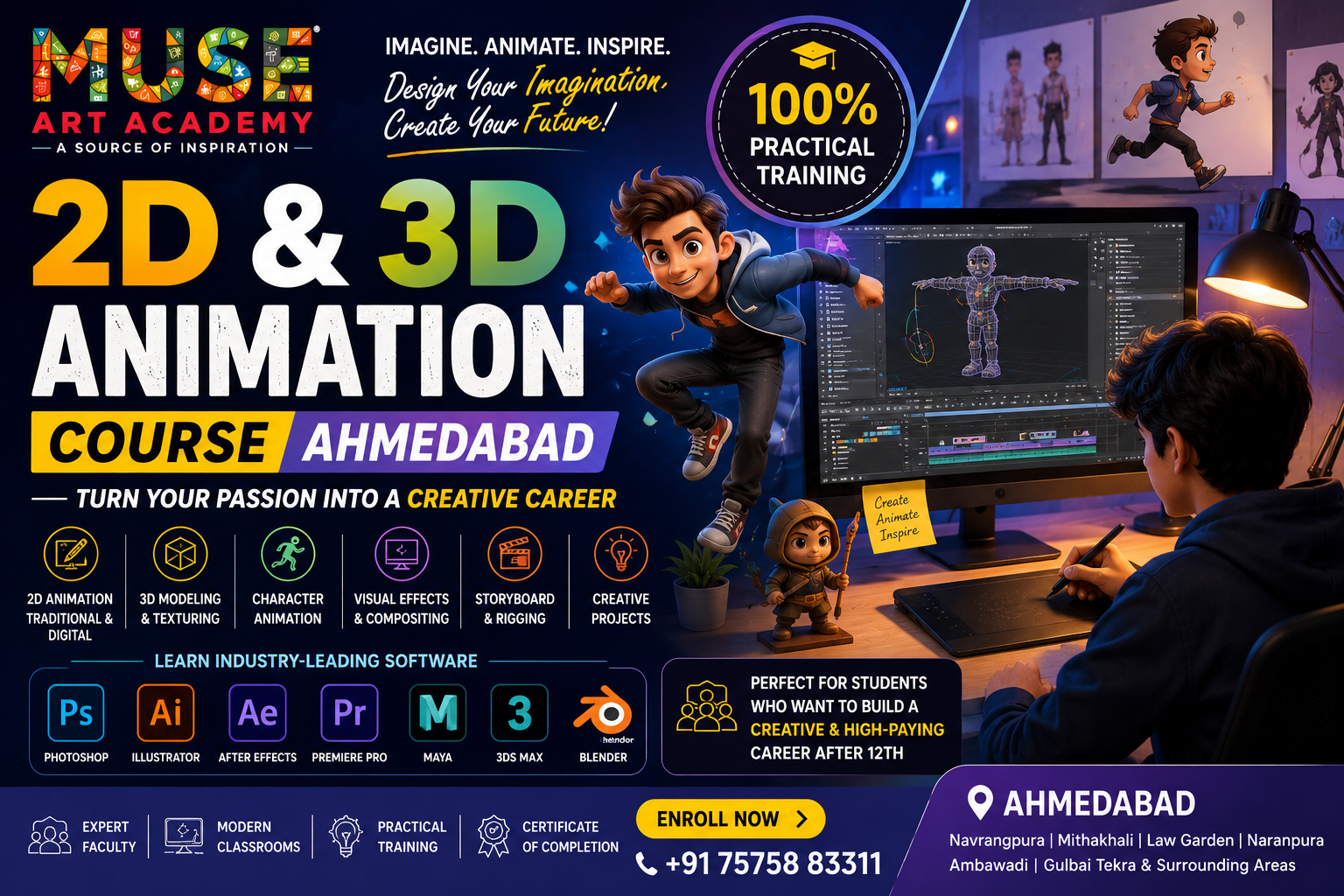
Professional animation requires knowledge of appropriate creative software. Depending on the program and curriculum, students can receive exposure to tools such as:
- Adobe Photoshop
- Adobe Illustrator
- Adobe After Effects
- Autodesk Maya
- Blender
- Premiere Pro
- Other industry-relevant animation and editing tools
Software knowledge combined with animation principles and project experience can help students become more versatile creative professionals.
Practical Project-Based Learning
Practical projects are one of the most important parts of a 2D & 3D Animation Course Ahmedabad.
Students can work on projects such as:
- 2D animation scenes
- Character design
- Animated logos
- Motion graphics
- Product animation
- 3D modeling
- 3D environments
- Short animation projects
- Explainer videos
- Promotional animations
- Visual effects projects
Practical assignments allow students to apply what they learn and understand how animation workflows operate.
Build a Professional Animation Portfolio
A strong portfolio is essential for students planning to enter the animation industry.
Instead of only displaying certificates, students should showcase actual projects that demonstrate their creativity and technical skills.
A portfolio can include:
- 2D animation
- 3D models
- Character designs
- Motion graphics
- Storyboards
- Product visualization
- Short animation films
- VFX projects
- Animated advertisements
- 3D environments
A professional portfolio can help students approach animation studios, advertising agencies, gaming companies, production houses, digital agencies, and freelance clients.
Career Opportunities After Animation
After completing a 2D & 3D Animation Course Ahmedabad, students can explore different career paths.
Potential roles include:
- 2D Animator
- 3D Animator
- 3D Modeler
- Character Designer
- Motion Graphics Designer
- VFX Artist
- Compositor
- 3D Visualizer
- Animation Artist
- Multimedia Designer
- Video Editor
- Game Art Artist
- Freelance Animator
Students can work in animation studios, advertising agencies, gaming companies, film and television production houses, digital marketing agencies, e-learning companies, architectural visualization studios, and media organizations.
Is Animation a Good Career After 12th?
Animation can be a rewarding career for students who enjoy creativity, storytelling, technology, drawing, design, and digital media.
Students do not need to limit themselves to one specialization. They can gradually develop skills across 2D animation, 3D animation, motion graphics, VFX, video editing, graphic design, and visual communication.
However, animation is a skill-driven profession. Regular practice, creative experimentation, software proficiency, and portfolio development are important for long-term career growth.
2D & 3D Animation Opportunities in Ahmedabad
Ahmedabad has a growing digital, advertising, media, design, and creative business ecosystem. Digital marketing agencies, advertising companies, production houses, startups, brands, and content creators require visual content for marketing and communication.
Students from Navrangpura, Mithakhali, Law Garden, Naranpura, Ambawadi, Gulbai Tekra, and nearby areas can consider Muse Art Academy for animation and creative education.
Frequently Asked Questions
Which is the best 2D & 3D Animation Course Ahmedabad?
The right animation course should combine animation fundamentals, 2D animation, 3D modeling, texturing, lighting, rendering, motion graphics, practical projects, software training, portfolio development, and career guidance. Muse Art Academy provides a practical learning environment for students interested in animation.
Can I learn animation after 12th?
Yes. Students can explore animation after completing Class 12. Students from different academic backgrounds can develop animation skills based on their interests and career goals.
What is the difference between 2D and 3D animation?
2D animation creates movement within a two-dimensional visual environment, while 3D animation uses three-dimensional models, environments, lighting, cameras, and rendering to create depth and realistic or stylized visuals.
Which software is used for animation?
Common tools include Adobe After Effects, Photoshop, Illustrator, Premiere Pro, Autodesk Maya, Blender, and other specialized creative software.
What jobs can I get after an animation course?
Career opportunities include 2D Animator, 3D Animator, 3D Modeler, Motion Graphics Designer, VFX Artist, Character Designer, 3D Visualizer, Multimedia Designer, and Freelance Animator.
Can I work as a freelance animator?
Yes. Freelance animators can work with advertising agencies, brands, content creators, startups, digital marketing companies, production houses, and individual clients.
Explore Other Creative Courses at Muse Art Academy
Students interested in related creative careers can also explore:
- Graphic Design Course in Ahmedabad
- Interior Design Course in Ahmedabad
- Fashion Design Course in Ahmedabad
- UI/UX Course Ahmedabad
- Photography & Videography Course Ahmedabad
- Video Editing Course Ahmedabad
- Multimedia Course Ahmedabad
Add contextual internal links from each course name to its respective Muse Art Academy course page. This will create a strong internal linking structure and help establish topical authority across your creative education categories.
Start Your Animation Career with Muse Art Academy
If you enjoy animation, storytelling, digital art, gaming, movies, motion graphics, or visual effects, a 2D & 3D Animation Course Ahmedabad can help you develop the creative and technical skills required for a career in the animation industry.
Muse Art Academy combines practical education, project-based learning, software training, portfolio development, and career guidance to help students prepare for creative opportunities.
Whether your goal is to become a 2D animator, 3D artist, motion graphics designer, VFX artist, 3D visualizer, or freelance creative professional, developing strong fundamentals and a professional portfolio can be an important first step.
Contact Muse Art Academy to learn about the latest course duration, fees, eligibility, curriculum, batches, and admission process.